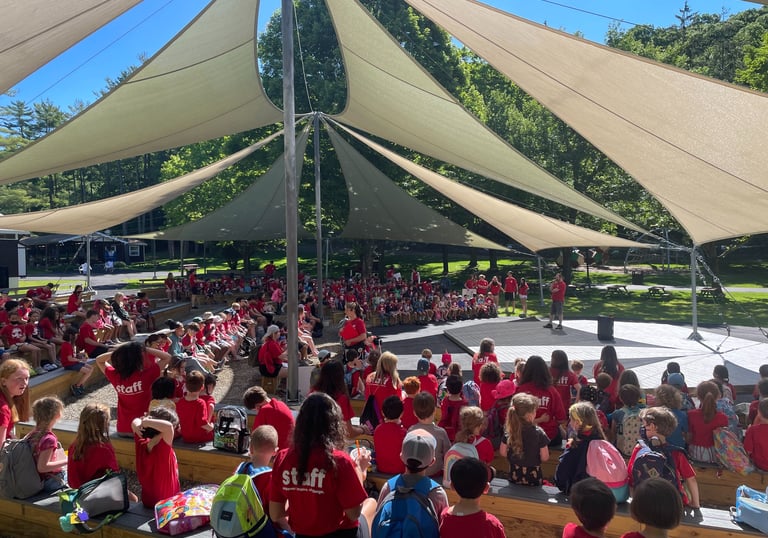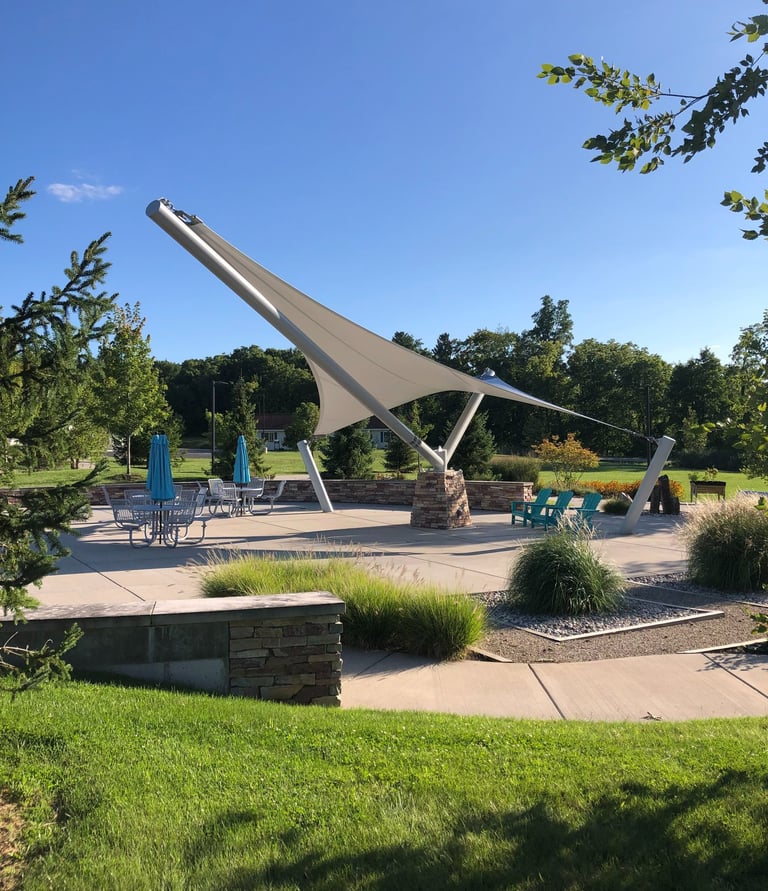
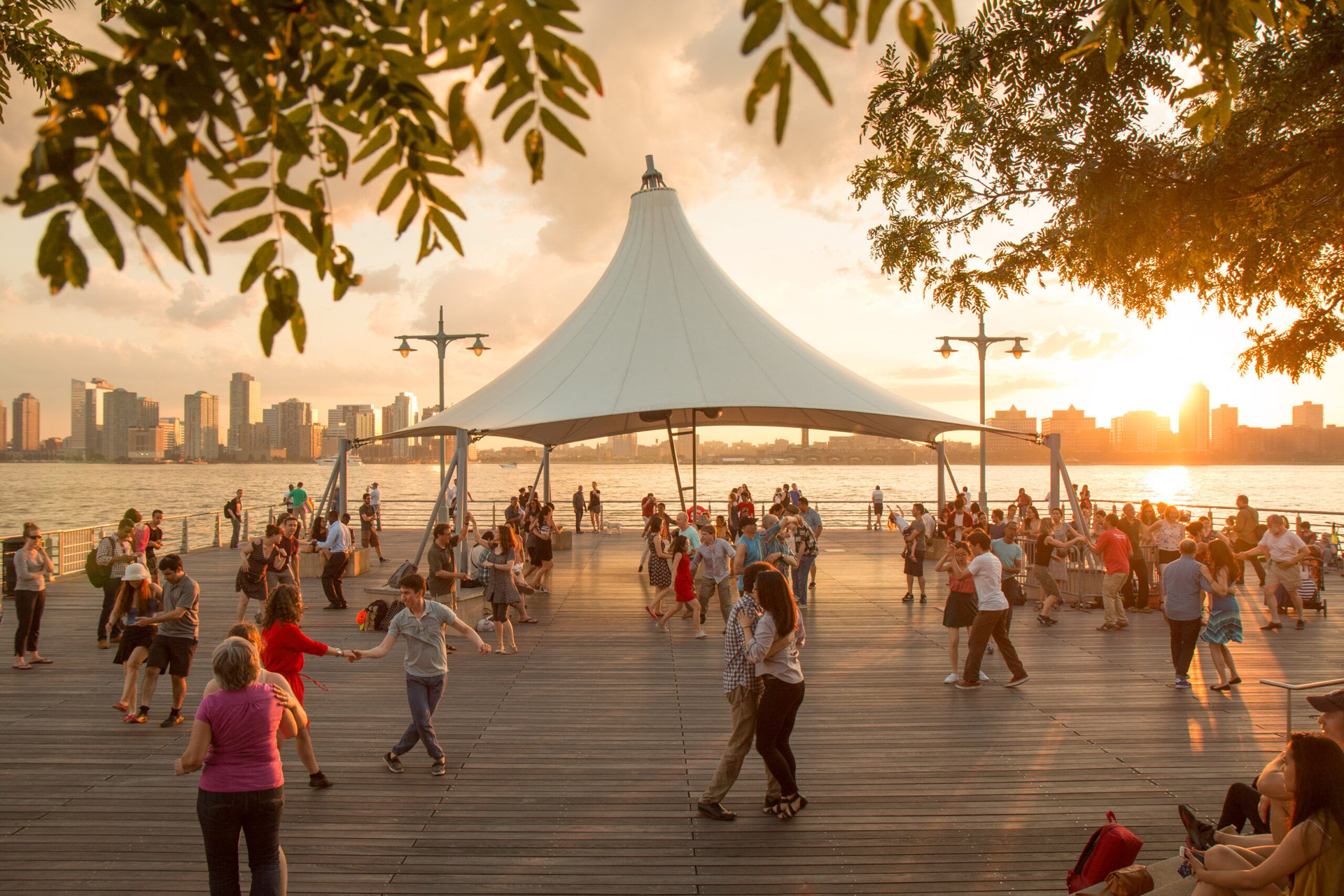
DSCN0576.JPG

Material Choices...Its all about the coatings.


Today’s architectural fabrics are composites of woven substrate fiber protected by an applied coating.  New fibers, primarily nylon, polyester, polyethylene and fiberglass, have been developed to fill the need for materials with high strength, longer life spans and a high modulus of elasticity.  The woven substrate provides the basic tensile strength of the material and its resistance to tear.  The finish coating applied to the substrate material seals the fabric against weather and dirt, provides resistance to ultraviolet light, functions as a medium for joining panels and, in most cases, incorporates fire-resistant properties.


As a building envelope, the latest architectural fabrics respond to heat and light much differently than previous generations of fabric, as well as offering features and benefits different from conventional construction materials.  Fabric can be translucent, yet highly reflective with low mass and thermal resistance.


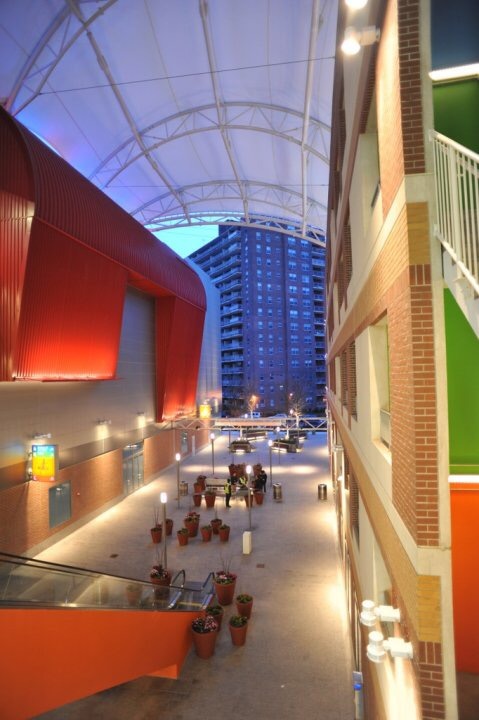
Architectural fabrics can be manufactured to vary in translucency from 1% to 95% and, in thermal resistance, from a single pane of glass to that of a conventionally insulated structure, while still maintaining adequate day lighting.  Once reflected, half of the remaining light is absorbed by the fabric and given off as heat energy.  The remaining light is transmitted through the material.  The roof can be a source of light at night by directing artificial light on its highly reflective surface.


FABRIC SELECTION

The performance of today’s architectural fabrics depends upon the weaving pattern, choice of substrate, and coating.  Each type of composite has unique properties and characteristics that suit it to different applications.  The proper selection of membrane material is based on the proposed structure’s size, form, function, project economics, and desired longevity. 


Membrane

The membrane forms the enclosure of the structure and can be fabricated a number of ways. It can be sewn, glued, electronically welded or heat-sealed. There are a number of seam styles, overlaps and reinforcements that differ from project to project. The final fabrication geometry for all aspects of a fabric structure should be derived from the same computer model or full scale frame.  Patterns are created using computer generated software which produces unfolded panels that represent the membrane in its stressed state. The panels are also sized according to the width of the fabric being used.  These panels are then modified or “compensated” to allow for the actual stretching of the membrane during installation.  Smaller structures, such as awnings, are patterned directly off a full scale frame.


Structural fabrics in common architectural use today include:


·         Teflon Coated Fiberglass (PTFE)

·         Silicon Coated Fiberglass (SiFE)

·         Vinyl Coated Polyester (PVC)

·         High-density Polyethylene (HDPE)

·         Laminates, Theatrical Drapery

·         Stretch Fabrics

·         Future Fabrics and Films


PTFE is used world wide as the preferred material for large-scale permanent structures or structures requiring long life and with specific construction code compliance requirements.  PTFE has excellent weather, temperature and chemical resistance in addition to its durability and strength.  This material has a life span of over 25 years and is manufactured in accordance to standards such as ASTM E-108 and E-84.  PTFE varies in translucency from 7% to 15% and reflects between 68%-75% of incident sunlight. The quality of light transmitted is color balanced, diffused and free of shadows and glare. 


Before installation, PTFE has an irregular off white or slightly brown color, which is caused during the manufacturing and fabrication process.  Once exposed to direct sunlight, the external surface of the membrane bleaches to a milky white within a matter of days. 


PTFE is the obvious option if long life and low maintenance are the most important factors in selecting a fabric.  This material requires heat-sealing at the seams to join fabric pattern sections.  Warranties for PTFE range from 10 to 15 years.


Other non combustible fabrics include silicone coated fiberglass and hybrid PTFE.


Silicon Coated Fiberglass is coated with silicone polymers. Newly formulated with improved seaming process, it has very high tensile and tear strength and is more flexible than most other materials. It is long lasting, flame resistance, dimensionally stable and is available in colors and has  high translucency.


The seaming process requires an adhesive which takes a short amount of time to completely cure. The seaming process is more efficient and the quality of the sema strength more consistent. Silicone coated fiberglass doesn’t generate any toxic fumes while burning which makes it safer than PTFE or PVC fabric structures.


PVC is the most cost effective membrane material and, therefore, an ideal choice for both temporary and permanent tension structures.  The fabric came into prominent use in the 1960’s replacing nylon, which had been used almost exclusively until that point.  The material is soft, pliable and less expensive than PTFE.  It is available in a variety of types to meet a wide range of structural requirements.  It has a minimum of stretch and shrinkage in a wide range of temperature and humidity conditions and the coating process prevents mildew, stain and streaking. 


Most PVC fabrics will have some form of top coating applied to keep them looking new and clean.  These topcoats can be acrylic solutions, polyurethane-acrylic solutions, PVDF solution coats or a PVF film lamination.  Vinyl laminated polyester is primarily used for temporary structures while vinyl coated polyester is used for both temporary and permanent structures. 


PVC material has a life span of 10-15 years.  It comes in a variety of colors and textures, but is subject to creep (stretching under load), thus requires periodic re-tensioning.  This material is sealed using radio frequency (RF) equipment.  Most PVC fabric producers warrantee their material for 10 years.


HDPE is a mesh material manufactured and used in a variety of ways.  This material can be made for agricultural shading or engineered and woven for structural purposes.  Shade mesh comes in a variety of styles, colors and shade factors.  A high-density polyethylene fabric provides high tensile strength, biaxial stability under load, UV stability, high UV absorption, and a Class A fire resistance in accordance with ASTM E-84.  This fabric is especially well suited for dry/hot climates where protection from sun and hail is desired. HDPE membranes are not waterproof.  This material is sewn using industrial machines.  Typically, High Density Polyethylene is warranted for 5-8 years.


Home    Step 1    Step 2    Step 3    Step 4    Step 5    Contact Me    News    Links    My Book    Featured Article    Español